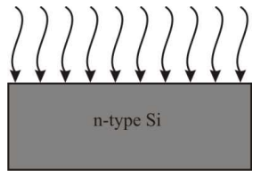
Consider a silicon sample at T = 300 K, with a uniform donor density Nd = 5 × 1016 cm-3 illuminated uniformly such that the optical generation rate is Gopt = 1.5 × 1020 cm-3 s-1 throughout the sample. The incident radiation is turned off at t = 0. Assume low-level injection to be valid and ignore surface effects. The carrier lifetimes are τp0 = 0.1 µs and τn0 = 0.5 µs.
The hole concentration at t = 0 and the hole concentration at t = 0.3 µs, respectively, are
GaAs has bandgap energy of 1.42 eV. The material would produce photon output at a wavelength of (Planck's constant = 6.625 × 10⁻³⁴ J - s, q = 1.6 × 10⁻¹⁹ C )
Consider the following statements:
1. The radiation falling on a photodiode is primarily a minority carrier injector.
2. The short-circuit current of a reverse biased photodiode under illumination varies exponentially with light intensity.
3. The photo voltage emf of an open-circuited photodiode varies logarithmically with the light generated short-circuit current.
4. The spectral response of a photodiode does not depend upon the frequency of the incident light.
Which of these statements are correct?
A reverse-biased diode placed in parallel with the base-emitter junction makes the circuit insensitive to variations in . . . . . . . . with changes in temperature.
Consider the following statements used in respect of the phenomenon- Population Inversion:
1. It means population in a higher state is higher than that in a lower state
2. It is observed under thermal equilibrium
3. It increases the rate of spontaneous emission
4. It increases the rate of stimulated emission
Which of the statements given above are correct?
A Silicon PN junction diode under reverse bias has depletion region width 10 µm. The relative permittivity Silicon, εr = 11.7 and the permittivity of free space ε0 = 8.85 × 10⁻¹² F/m. The depletion capacitance of the diode per square meter is